GDP grew 4.3% in Q3 2025. Consumer spending held up. Inflation moderated to 2.7%. If you’re building your 2026 plan off these numbers, you’re probably making a mistake.
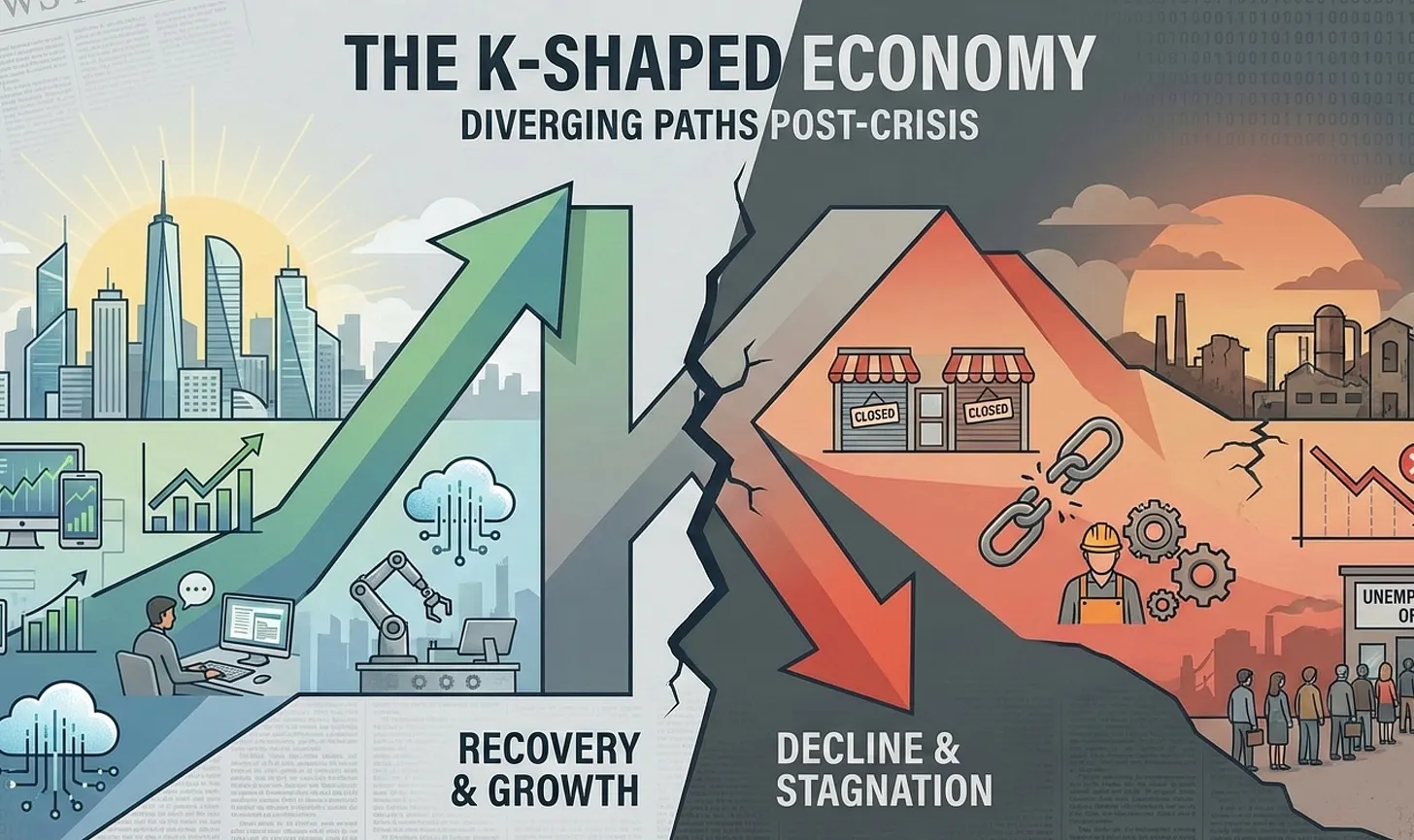
The aggregate data describes an economy that doesn’t exist for most businesses. What actually exists is two economies running in parallel—one for households earning over $200K, another for everyone else. The first group is doing well. The second is stretching.
This isn’t a new observation. People have been talking about K-shaped recovery since 2020. What’s useful now is looking at where the pattern shows up in actual purchasing behavior, and what that means for business planning.
The Restaurant Industry as Economic Seismograph
Restaurants are useful for assessing the economy because they sit at the boundary between necessity and discretion. People need to eat, but they don’t need to eat out. When money gets tight, restaurant spending is one of the first things to flex.
Here’s what the data shows:
Quick service (fast food) illustrates the complexity of this environment. The conventional wisdom is that QSR benefits from trade-down—when budgets tighten, a $7 combo meal replaces a $14 fast-casual bowl. But the segment share data tells a different story. QSR is actually faring the worst in terms of traffic share changes versus year ago.
This makes sense when you look at the full picture. QSR’s core customer base skews heavily toward the economic, demographic, and ethnic groups under the most pressure in this bifurcated economy. And while fast food might benefit from some trade-down from fast casual, it’s the segment most vulnerable to grocery trade-out. Grocery pricing has been increasing at a more subdued rate than QSR prices, making the home-cooked alternative increasingly attractive for price-sensitive consumers. The same households that might trade down from fast casual to QSR are the ones most likely to trade out of restaurants entirely.
Fast casual is getting squeezed from both directions. At $12-15 per meal, these concepts are expensive enough that budget-conscious consumers are trading down to QSR, but not differentiated enough to compete with full-service options for people willing to spend more. The middle is an uncomfortable place to be.
Casual dining—the segment everyone wrote off as dying—is actually outperforming on same-store sales growth. The mechanism is aggressive pricing and bundling designed to drive value perception. In some cases, these offers encroach on the price point of limited-service experiences while delivering full-service hospitality—table service, unlimited refills, atmosphere. This calls into question the value proposition of fast casual altogether. Why pay the same price to stand in line and bus your own table?
Fine dining remains resilient among affluent consumers. High-income households benefited from asset appreciation over the past few years. They’re still spending.
What This Pattern Suggests
The restaurant data is consistent with a specific hypothesis about current consumer behavior: spending is holding up not because of broad-based income growth, but because of wealth effects at the top and credit/savings drawdown in the middle.
Real disposable income was essentially flat in Q3 2025. If people are spending at roughly the same rate but income isn’t growing, the math implies they’re funding it from somewhere else—either accumulated savings or debt. That’s not necessarily a problem in the short term, but it does suggest fragility. Credit-fueled spending has natural limits.
The distribution matters too. Unemployment sits at 4.6% overall, but 8.3% for Black workers. Trade areas with high concentrations of Hispanic population are showing measurable weakness in customer traffic counts. The pain isn’t evenly distributed.
The Planning Implication
None of this is predictive in a precise sense. I can’t tell you consumer spending will drop X% in Q2 2026. But it does suggest that planning based on aggregate indicators carries more risk than it might appear.
If your customer base skews toward households earning under $75K, the relevant economy for your business looks different than the headline numbers suggest. These customers are more price-sensitive, more likely to be funding discretionary spending from finite reserves, and more vulnerable to any additional economic stress.
If your customer base skews affluent, current conditions are more favorable—but that doesn’t mean permanent. Asset-driven wealth can reverse quickly if markets correct.
The businesses showing relative strength right now share a common trait: clarity about who they serve and how they deliver value to that specific segment. QSR winning on unambiguous value. Fine dining winning on experience for people with means. Casual dining finding a niche by offering full-service experience at fast-casual prices.
The businesses struggling tend to be stuck in the middle—too expensive for value-seekers, not differentiated enough for premium buyers.
This probably generalizes beyond restaurants. In a bifurcated economy, strategic ambiguity becomes more costly. Trying to serve everyone means optimizing for an average customer who increasingly doesn’t exist.
What I’d Watch
A few indicators that would either strengthen or weaken this hypothesis:
Consumer credit data. If revolving credit growth accelerates while income stays flat, that’s a sign the spending-from-reserves pattern is intensifying. Probably not sustainable.
Savings rate trends. Personal savings rate has already declined. Further drops would suggest consumers are running out of runway.
Asset prices. A meaningful market correction would likely trigger rapid spending pullback among the affluent segment that’s currently propping up the premium end.
Unemployment by demographic. If the gaps widen, expect the bifurcation to intensify.
These aren’t predictions. They’re conditions to prepare scenario plans against.
———
The economy is strong in aggregate. But aggregates are averages, and averages can mislead. The question for any business isn’t whether the economy is growing—it’s whether your specific customers are participating in that growth, and how durable their current spending patterns actually are.
Share