This graphic has been making the rounds. You may have already seen it.
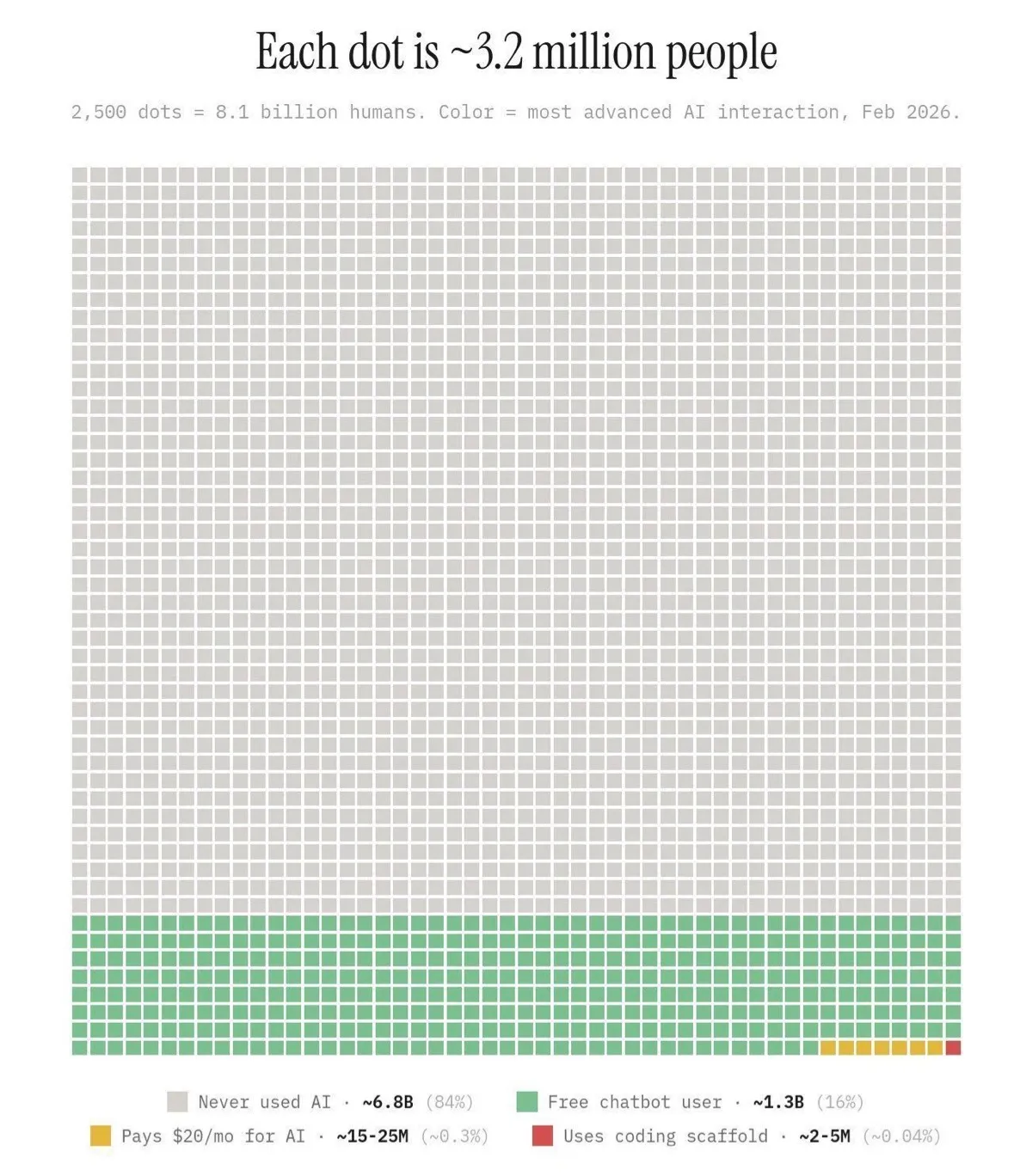
Each dot represents 3.2 million people. The entire grid is 8.1 billion humans — every person alive on earth as of February 2026. The color tells you their most advanced interaction with AI.
Gray: never used it. That’s 6.8 billion people. 84% of humanity.
Green: used a free chatbot. 1.3 billion people. 16%.
Yellow: pays $20/month for AI. 15 to 25 million people. About 0.3%.
Red: uses a coding scaffold or purpose-built AI system. 2 to 5 million people. 0.04%.
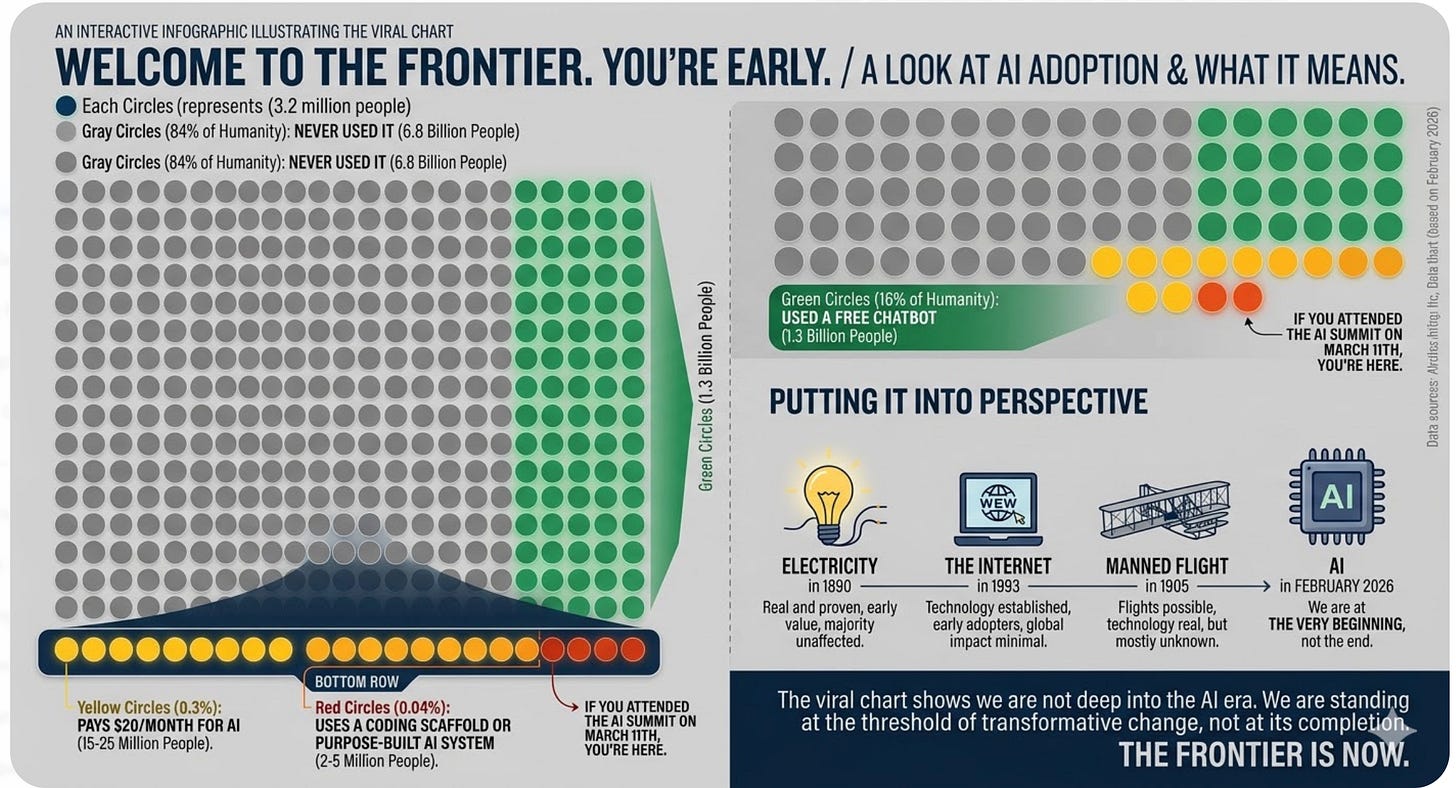
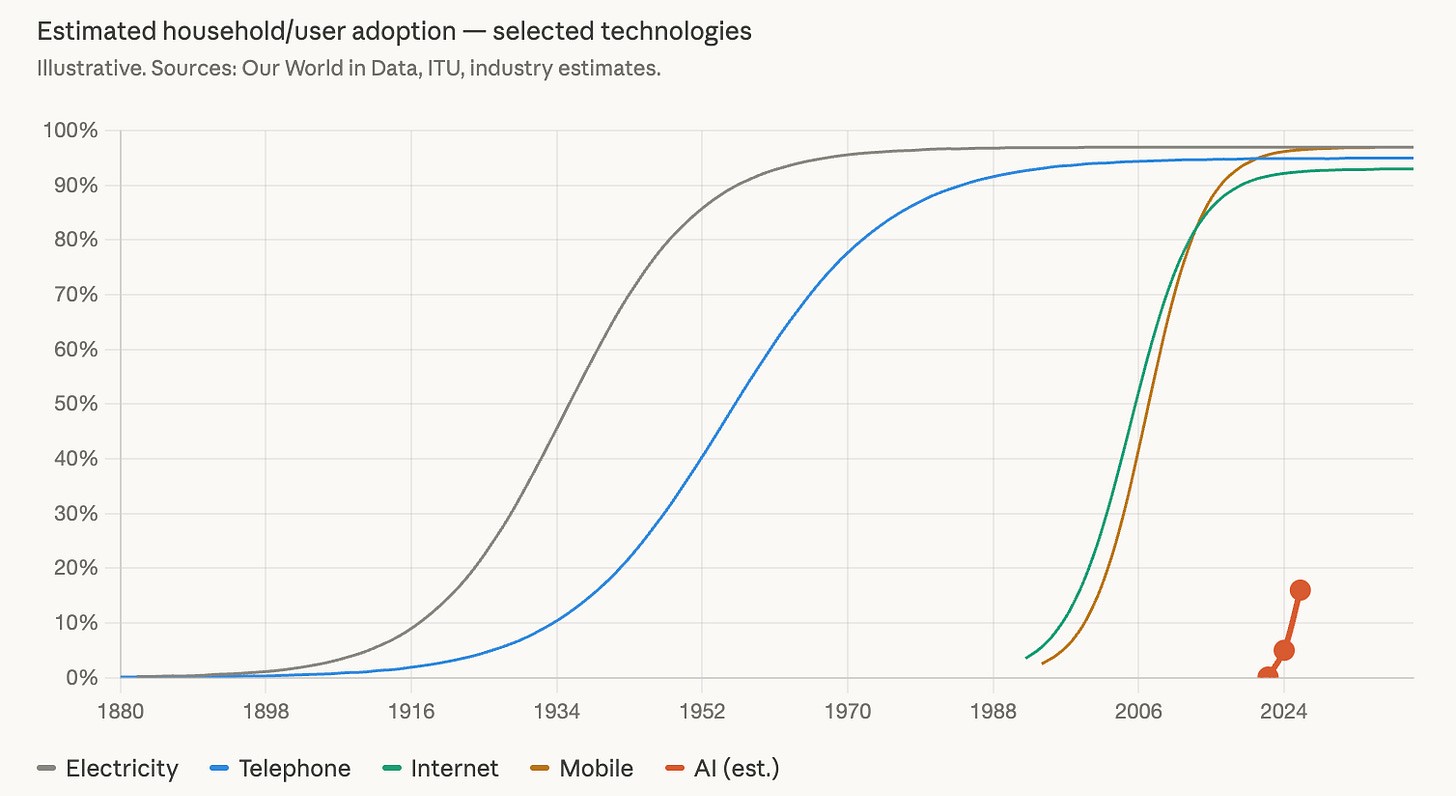
It’s gone viral because it puts something into perspective that most technology coverage gets wrong. We are not deep into the AI era. We are at the very beginning of it. Think about where electricity was in 1890, or the internet in 1993, or manned flight in 1905 — moments when the technology was real and proven, early adopters were already extracting value from it, and the overwhelming majority of the world hadn’t yet felt its effects in any meaningful way. That’s the dot chart. That’s where we are.
If you were in the room at MURTEC’s AI Summit on March 11th, you are somewhere in that bottom row. And the math says you are standing at the beginning of something, not the end of it.
There’s a moment I want to call out from the Summit’s executive briefing. The framework presented was called the “Disappearing Middle of Work.” The argument was this: historically, the bulk of any technical team’s time was consumed by manual execution — the middle layer between deciding what to do and reviewing whether it worked. AI is collapsing that middle. What remains are the two bookends — forming intent and reviewing outcomes. Everyone in that room on March 11th was there, in part, to understand what that means for how they run their organizations.
Worth noting: the executive briefing itself was AI-generated. That’s not a footnote — it’s the demonstration. A document that educated a room full of restaurant tech executives on AI foundations was itself produced by the technology it was describing.
Aaron Newton of Thanx put it plainly from the stage: you can still learn this. The only thing limiting your ability to harness AI is your own imagination. His message was notable for what it didn’t include — buzzwords, vendor pitching, false urgency. Just a clear-eyed account of what’s available and what’s possible for anyone willing to engage.
None of what happened on March 11th was accidental. The easy version of an AI conference in 2026 is a vendor showcase dressed up as education — speakers talk about their products, the audience leaves with a tote bag and no framework.
Abby Lorden built something different, and it was a genuine risk. The AI Summit was architected to pull the hype out of the room and force the audience to sit with the unsexy parts: data cleaning, naming conventions, governance structures, security posture. Not the content that gets standing ovations. Also the reason most AI implementations fail.
It drew a packed room that stayed packed. In a conference environment where every session competes with networking and noise, that’s the only verdict that matters.
Bravo to Abby Lorden and the MURTEC team. You made the hard call, built the right agenda, and the industry showed up for it.
One of the most instructive moments from the Summit was presented by Jenn Faren from Hopdoddy. The same question — identify the top-selling menu items — was put to two different systems side by side. A general AI, fed actual Hopdoddy sales reports, analyzed the data and returned a confident answer: Greek Salad was their top seller. Hopdoddy doesn’t serve a Greek Salad. The system didn’t hallucinate from thin air — it hallucinated from real data. That’s a more unsettling failure mode, not a less serious one.
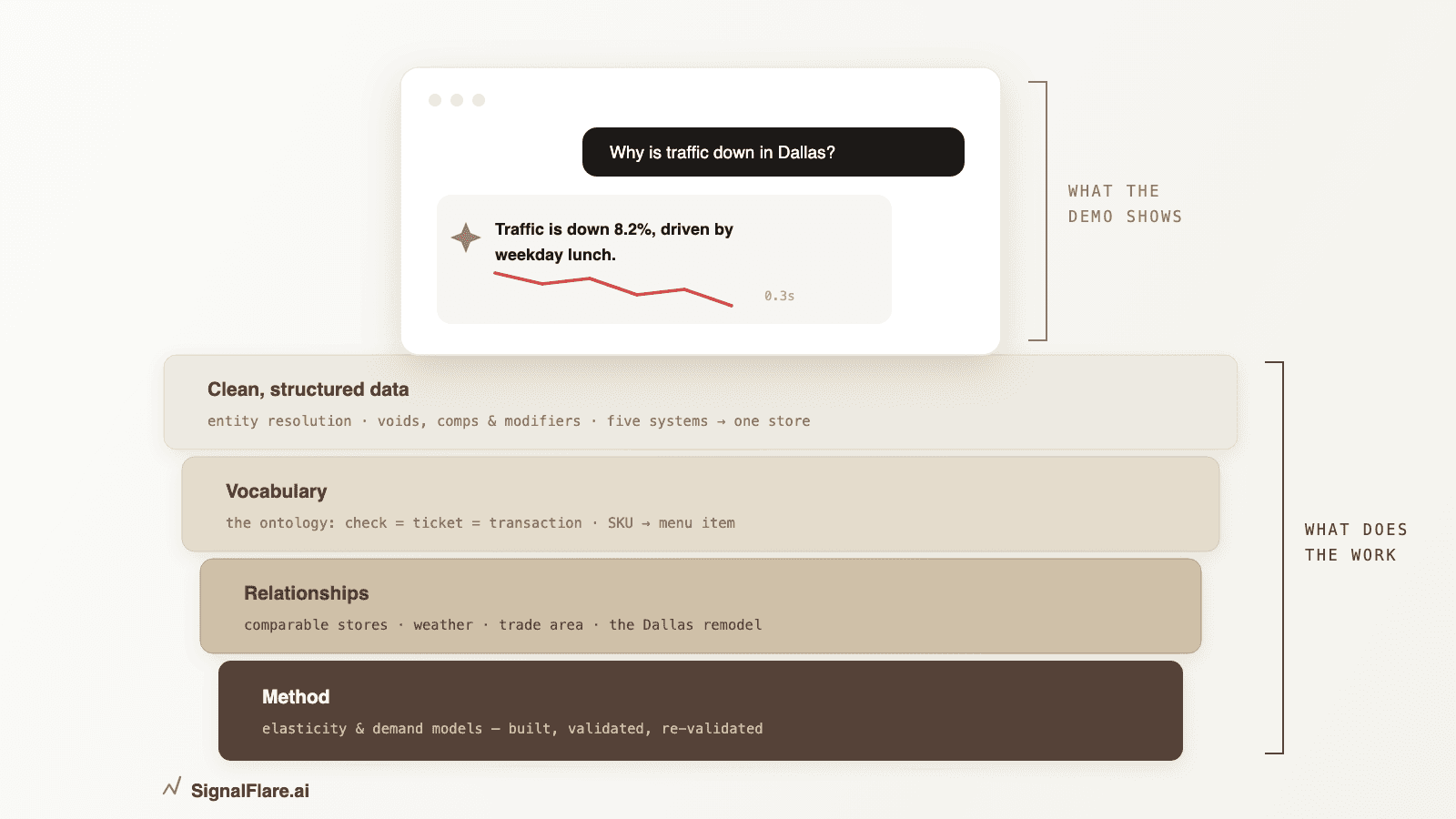
The same question, asked of SignalFlare Navigator, returned a ranked analysis grounded in Hopdoddy’s actual item master — accurate, sourced, and traceable. Not because Navigator is a smarter AI, but because it’s a different kind of system entirely. Navigator is built on restaurant domain ontology and semantics — the specific vocabulary, hierarchies, and business logic that make a restaurant operation legible to a machine. It functions as a deterministic router, not a probabilistic guesser. When you ask it a question, it doesn’t generate a fluent-sounding answer. It finds the right one.
That contrast did something important for the audience beyond making a product point. Most people in that room already use AI tools. Far fewer understand what’s actually happening inside them, or why the same question returns a reliable answer in one system and a fabricated one in another. Using the right tool for the right purpose has always mattered — that principle didn’t change when AI arrived. What changed is that the tools are harder to evaluate from the outside, because they all look fluent. Understanding the differences is exactly what a day like the AI Summit was designed to teach. This session delivered that lesson better than any slide could.
Patrick Bobrukiewicz from Thrive Restaurant Group described the other side of that same equation: an agent that synthesized credit card spend and demographic data to identify not just which zip codes to target for marketing spend, but which ones to suppress — because discretionary income was too low or brand awareness had already peaked. That recommendation required the system to reason within a defined framework, not generate a generic suggestion. That’s the difference between a thought partner and a search engine with confidence.
Skip Kimpel of the Restaurant Technology Network delivered one of my favorite sessions of the day — on my favorite topic: data readiness, the real foundation that every AI conversation in that room was standing on. His message was unambiguous: AI fails because data fails. Inconsistent naming conventions, undefined KPIs, siloed systems — these aren’t IT problems, they’re AI problems. A model trained on bad data doesn’t fail loudly. It fails quietly, confidently, and at scale. There is no shortcut from messy data to reliable AI. Every operator in that room needs to hear that before they buy anything.
The day itself built on a foundation Sol Rashidi had already laid — her keynote the day prior was the perfect setup and foreshadowing for what was coming: grounding the room in what AI actually is, what it isn’t, and why this moment requires leadership attention, not passive observation.
What followed was some of the most practical sharing I’ve seen at any industry conference. A few that stood out: Dave’s Hot Chicken’s Leon Davoyan applied agentic AI to third-party delivery marketing at the store level — +9.4% same-store sales and +1% margin. Taco John’s Steve Smyth gave an honest account of their voice AI journey: launched, pulled back, fixed fundamentals, launched again — now at 93% non-intervention across 45 restaurants. Jeremy Lanni of Latitude Food Group cleaned up 20,000 menu records and built a conversational AI for field leaders, running IT as a department of one. Kim Lewis of Capriotti’s demonstrated her AI leadership twin “Kimbot” — smart prompting applied to cloning management style, practical enough that the audience was photographing her prompts in real time. And Aaron Newton of Thanx delivered the sharpest brand strategy observation of the day: if you don’t own the guest relationship, the AI in their pocket will.
Not a dull moment. The right people took the stage and shared what they actually know — which, in this industry, turns out to be quite a lot.
I heard it from a lot of people in that room — technologists, operators, executives — a quiet concern that they’re already falling behind. That the window is closing, or has closed. But that’s not where we are.
Wilbur and Orville Wright flew at Kitty Hawk in December 1903. By 1906, they had made dozens of flights and held the first airplane patent. If your benchmark for “too late” was 1906, you would have missed commercial aviation, the jet engine, the moon landing, and every airline ticket ever sold.
We are in 1906. The people in that room at MURTEC on March 11th are the ones who showed up at Kitty Hawk to watch and learn and figure out what comes next. The 84% gray dots haven’t arrived yet. The runway — in every sense of the word — is almost entirely ahead of us.
The operators who build AI fluency now — who understand the difference between a general chatbot and a purpose-built agent, who invest in data foundations, who treat this moment as an invitation rather than a threat — will have a structural advantage that compounds over time. Knowledge bases improve. Agents learn. The compounding only starts when you start.
If you were in Las Vegas on March 11th, you were there at the right time. Welcome to the frontier. It’s early. And that’s the point.
A note of thanks to the founding and visionary sponsors who made the AI Summit at MURTEC possible: SignalFlare.ai, Craftable, Momos, and newo.ai — and to the full sponsor community whose presence made the day a practical demonstration of just how much is being built for this industry right now.
Share