“The biggest struggle as CEO is synthesizing large volumes of data – I often trust the people around me more," a prominent CEO of a multi-thousand-unit restaurant brand said at a conference last summer. He went on to say that this constrains his organization to three to five big ideas per year. It likely does not surprise you to hear that making use of restaurant data at scale, even with considerable resources, is a challenge.
Most multi-unit restaurant leaders scaling their businesses go to great lengths to find critical answers in their data – hiring analysts, bringing in consultants, and building business intelligence capabilities to do so. Since VisiCalc (the precursor to Excel), the primary solution for data-driven decision-making has been manual data engineering, domain expertise, and significant human effort — addressing complex problems like pricing, menu engineering, site selection, demand generation, labor optimization, supply chain management, and even the quality of the in-store experience.
More recently, two new categories of solutions have emerged, promising to answer boilerplate questions about store performance and unlock previously unreachable answers. As one CEO I spoke to recently put it, "we just ask a question…and it shines a light in a really deep, dirty corner that we've never seen."
The two new categories: Horizontal and Vertical agentic AI platforms.
Both represent a valuable departure from the old model. But they are not the same, and the difference matters more than most leaders realize.
Intelligence
The goal with data is to convert it into “intelligence” – reliable and trustworthy insights that support better decisions.
In today’s paradigm, the problem is that the process is persistently slow and expensive, dependent on whoever has the skills and the time. It can take days for a simple report, weeks for a consultant's recommendation. By the time there's an answer, the market may already have moved. This paradigm has left the restaurant industry in a reactive decision-making cycle for decades, costing billions of dollars in lost revenue from inaction, mistakes, and missed opportunities.
That said, in many ways, the fact that it takes so much time and money makes solving it in any other way no easy feat. When you take a close look at the workflows that build this intelligence, you see that analysts and experts manually and painstakingly bring together and analyze siloed datasets, expertly synthesize the data into insights by framing questions and setting criteria for each analysis, and then craftily produce reports, sometimes with data alone, sometimes layered with expert judgment.
What makes this intelligence trustworthy – when it works – is that the people producing it know the unique business context.
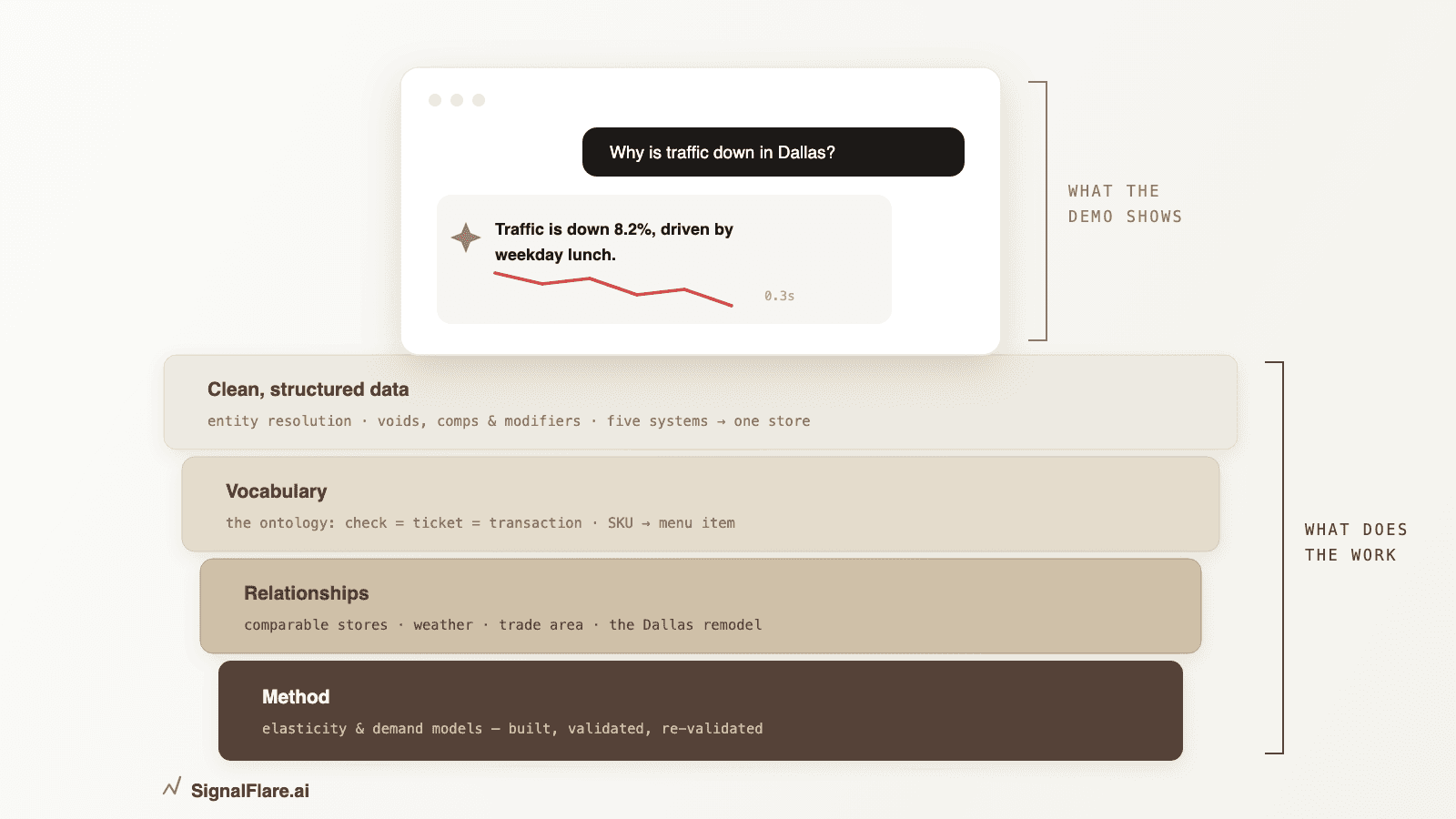
With agentic AI, the criteria for producing the same quality of intelligence is actually the same. The agents need meticulously cleaned data mapped into the proper infrastructure, the right context used at the right time, and encoded domain knowledge to ensure accurate analysis and recommendations.
If these criteria are met, then the benefits are exponential — intelligence at unprecedented speed, level of effort, and reach. Ask why store #47's profits are declining, and AI agents can surface patterns from trade area, POS, and sentiment data in seconds. The promise is real: intelligence that used to require a full project team, delivered on demand.
Vertical vs. Horizontal Agentic AI
Let’s now take a look at the difference between horizontal and vertical agentic AI.
Horizontal agentic AI: platforms like OpenAI's Frontier (launched just last week), Anthropic's Claude Cowork, and venture-backed startups like Abacus.AI and Manus.AI. These platforms position themselves as the "operating system of the enterprise" – a universal layer where AI agents connect to your data, reason over your systems, and execute workflows across any industry, any function, any use case.
Verticalized agentic AI: platforms built specifically for an industry's decision-making needs. In restaurants, this means systems designed from the ground up to understand POS data, trade area dynamics, menu economics, labor models, and the dozens of other domains where restaurant operators need intelligence.
The difference becomes concrete fast. To ask why store #47's profits are declining on a horizontal platform, you first need to connect your POS, normalize the data, define what "profit decline" means in your context, build the logic to decompose comps into traffic and check, integrate trade area data, and teach the system which patterns actually matter for your concept. Then you can ask the question. Horizontal platforms don't provide these things out of the box and are significantly more liable to fail when scaled. They’re in the business of tool building, not solution building, and especially not for any single industry.
With a vertical platform, the agents already know how to triage transaction data, trade area shifts, and product mix. You ask the question. You get a diagnosis. The restaurant intelligence is baked in.
What restaurant intelligence actually requires
Now that generating intelligence is no longer arduous, we should look at what it takes to produce intelligence you’d trust enough to act on.
Again, AI has the same required ingredients for reliable intelligence – understanding of context, clean data infrastructure, built-in accuracy checks. Domain specific intelligence takes it a step further.
We don’t want anyone in the industry to underestimate what it takes to create reliable restaurant intelligence, so we’ve identified the four keys to success below:
Numbers and meaning must live together. To understand why comps are soft, you need statistics (is the drop real?) and interpretation (what's driving it? what's the action?) in one system. Current tools separate analysis and interpretation, so the AI doesn't truly grasp the numbers. Restaurant decisions, like pricing or site selection, blend math, behavior, and competitive context. This cannot be solved with a BI tool and a chatbot.
Memory matters. Standard platforms use conversation history as context, feeding everything back to the system. Agentic AI that is built to last proactively incorporates relevant past data, like pricing comparisons or transaction loss analysis, into new analyses, ensuring you don't start from scratch when investigating issues like slipping guest satisfaction.
Effective restaurant AI requires the right data, correctly interpreted, not just more data. A horizontal platform lacks the nuanced understanding of your concept's specific demographics (e.g., 25-44-year-olds) or location needs (e.g., traffic counts for drive-thrus vs. urban stores). Restaurant intelligence needs dozens of signals beyond POS — like trade area demographics, competition, local events, weather, labor, and supplier trends. These signals must be integrated, mapped to your locations, connected to performance data, and structured for system-wide reasoning.
Domain expertise is the thread
What ties all of this together, the fourth key, is domain expertise. It tells the system which patterns matter, which context to pull, and which signals are noise.
You can let a generic AI learn your business from scratch. But it's like handing your kitchen to a surgeon. They’re smart, sure, but probably not who you want preparing the Dover Sole.
Vertical platforms have done this work. You're not buying infrastructure and a promise. You're buying intelligence that works.
The gap between demo and deploy
Companies are rushing to integrate AI without understanding the problem they're solving.
At first, it seems easy — plug in APIs and go. But for analytical work that requires accuracy and reasoning, off-the-shelf tools quickly hit a wall. Hallucinations creep in. Users ask why AI can't see data outside its silo. New use cases emerge, but the infrastructure can't support them.
Most enterprise AI fails here. Not because the technology doesn't work, but because nobody built it to last. AI can now produce intelligence at speed, but only when restaurant intelligence is already encoded into the system.
That's what we're building at SignalFlare. Navigator is an agentic explorer that supports restaurants' strategic decision-making. Our agents know when to calculate and when to reason. It structures memory the way businesses work. It connects your POS, trade area, and external data into a hub where the system can reason across all of it. But the platform is only part of it. We're encoding domain expertise into every workflow we craft for our customers, into the agents that serve users, and into the data infrastructure that feeds Navigator. Not as a feature — as the foundation.
At scale, the whole organization changes. Analysts spend their time on strategy, not data retrieval. Decision-makers get actionable intelligence that enables more efficient execution. The knowledge stays in the system instead of walking out the door when someone leaves.
Learn more about early access to Navigator
Share