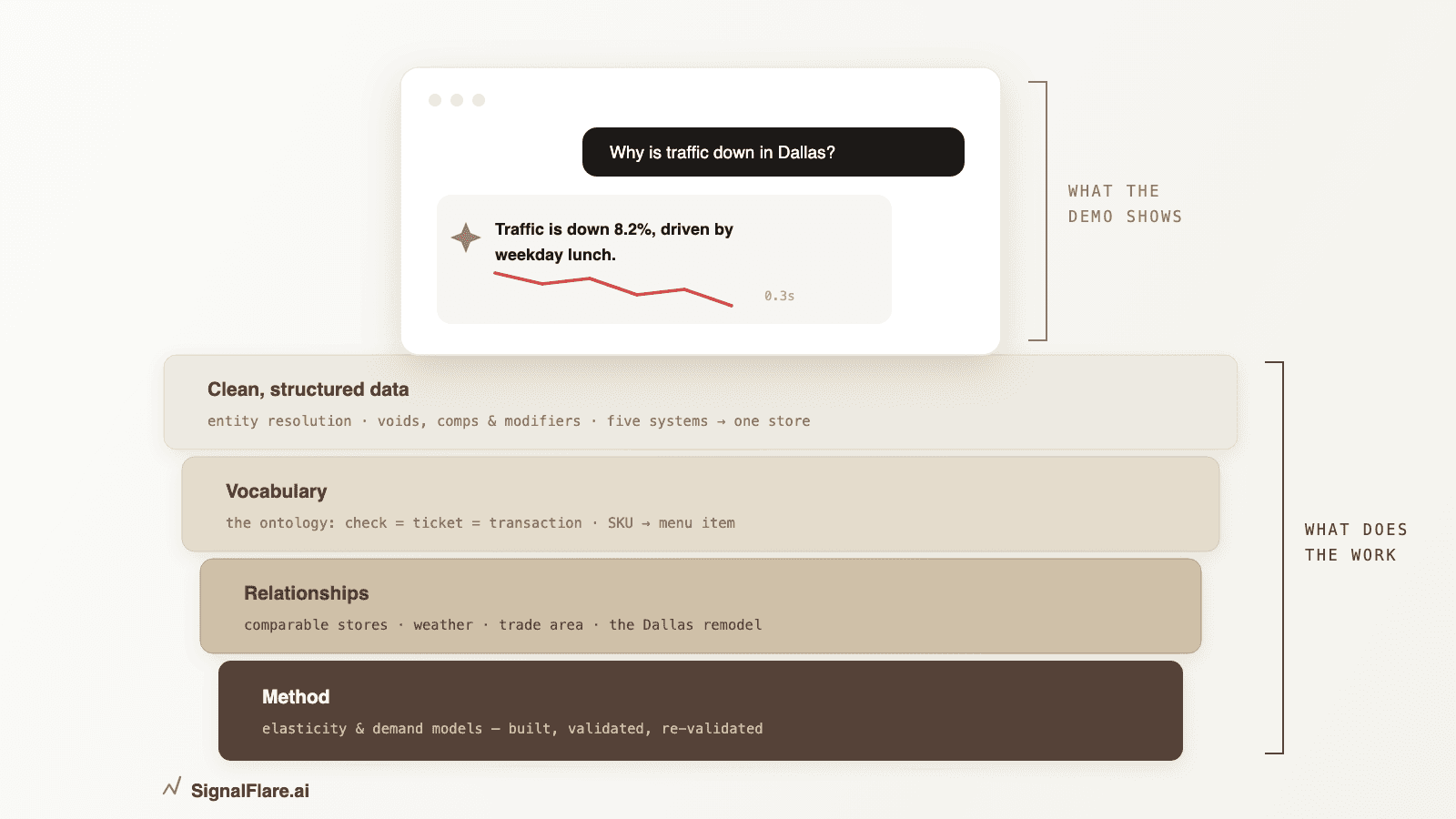

I have been advocating for the need for Decision Intelligence since before the industry — or the technology — was ready for it. The Death of Dashboards made the case for why: reports that describe the past don’t help anyone decide what to do next. Understanding Decision Intelligence laid out what replaces them: systems built around decisions, not displays. And Tear Down the Walls made the prediction: every software vendor would bolt AI chat onto its dashboard — “like putting a Maserati steering wheel on a Honda Civic.”
The prediction was easy to make and uncomfortable to watch come true. That is now the standard product roadmap: nearly every SaaS dashboard ships a generative chat window on top of its data. Cheap to build, easy to demo, and nothing changed underneath. A chat window is not Decision Intelligence — and both ideas that weren’t ready for their market are ready now.
A companion piece, The Four Bands of AI, Revisited, updates the framework itself — two questions instead of one ladder, and the four layers under the bands. This one is about what the bands mean when the job is analysis.
What Business Analysis Actually Requires
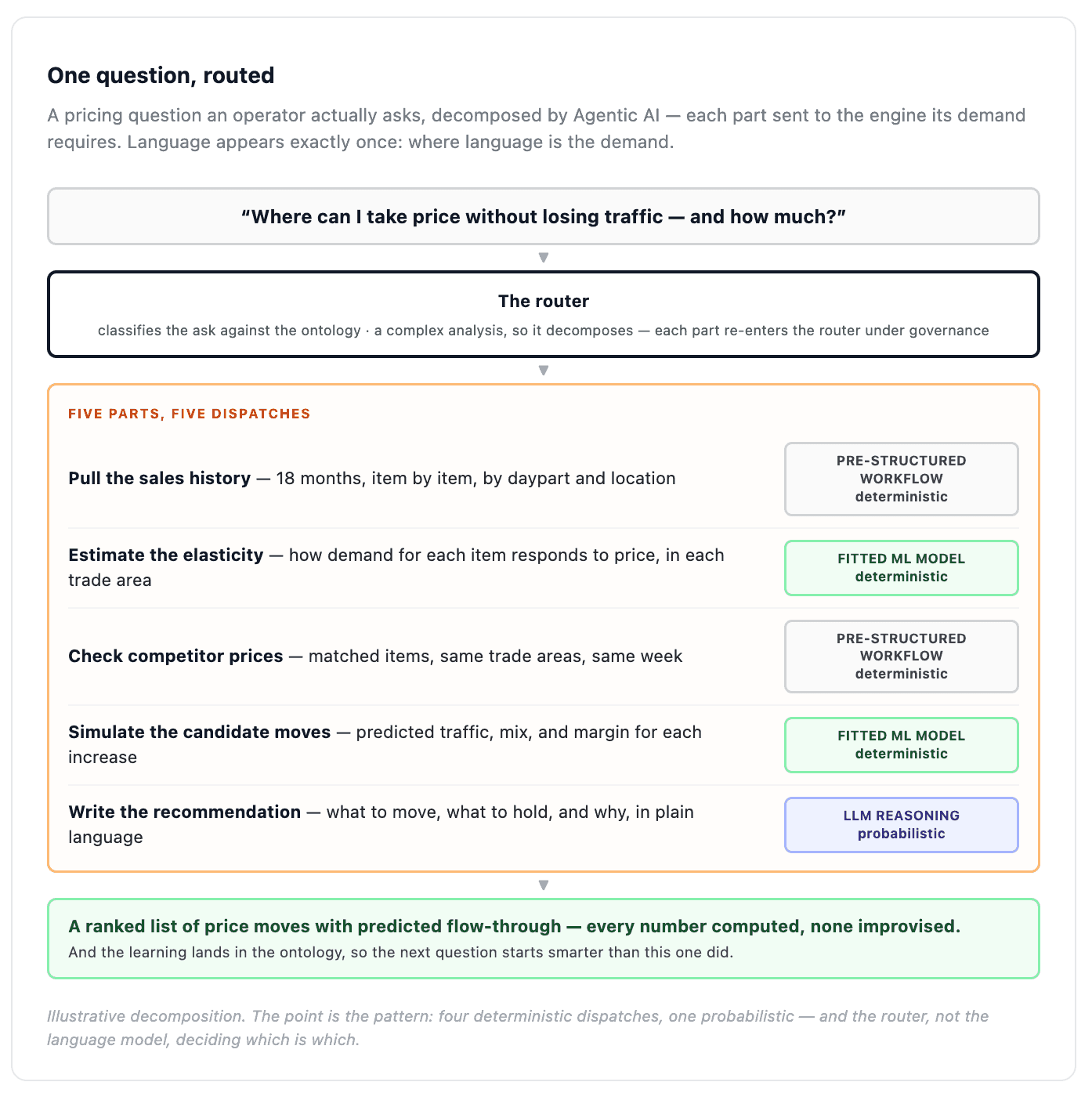
A real analysis pulls numbers from structured databases, runs models against them, and applies reasoning to the results. Some steps demand deterministic accuracy — the same answer twice. A revenue figure. An elasticity. A forecast. Other steps demand probabilistic reasoning — interpretation, synthesis, language.
That mix is what makes the work hard, and it is why none of the popular shortcuts carries it. A single-loop agent cannot hold a multi-step analysis. A frontier LLM on its own cannot compute one. A lone ML model answers exactly one question. Complex analysis needs all four bands — and something that decides, step by step, which one each demand should reach.
Three Machines from the Same Four Parts
All four bands are commodities now: machine learning services, Gen AI APIs, agent frameworks, orchestration platforms. “Which bands do you have” stopped discriminating. What discriminates is composition — and specifically, what routes.
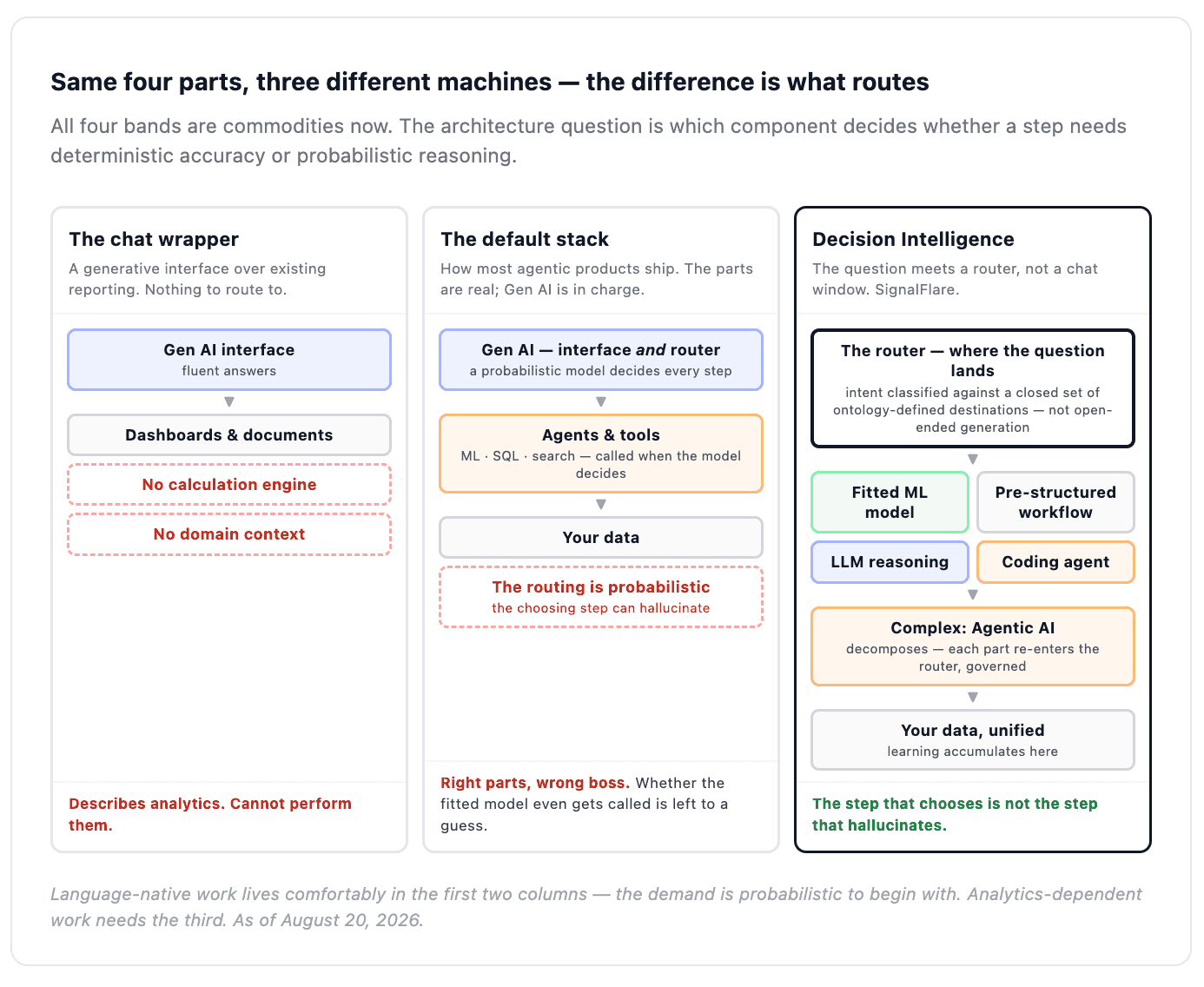
The chat wrapper is a generative interface over whatever reporting was already there. It can describe analytics. It cannot perform them — and on pricing or forecasting, the fluency conceals the absence.
The default stack is how most agentic products ship, whether assembled from a hyperscaler toolbox or bought as a platform. The parts are real: ML models, SQL, search, agents. But Gen AI sits on top as both interface and router, so a probabilistic model decides every step — including whether the fitted model gets called at all. Right parts, wrong boss.
For language-native work — legal review, support, copy — that default is acceptable, because the demand was probabilistic to begin with. For data work, it puts the one component that can hallucinate in charge of when accuracy matters.
The Router Is the Departure
Decision Intelligence inverts the default. The question meets a router first, not a chat window. The router determines what should answer: an LLM, a fitted model, a coding agent, or a pre-structured workflow.
Governed means something specific here. The router classifies intent against a closed set of destinations the ontology defines. Generative AI may interpret the question — it cannot invent a place to send it. Even the coding agent is a governed destination: sent there deliberately, its output checked. That is different from a chat model improvising a regression mid-answer and calling it one. Complex analyses go to agentic decomposition, and each part re-enters the router under governance.
This is why the argument keeps returning to ontology, semantics, governance, and curated data. They are not compliance garnish. They are what makes the routing deterministic — and they are why the system knows a check and a ticket are the same object before any of it means anything.
Why the Substrate Is the Product
When every dashboard has a chat window, the interface is worth nothing and the substrate is worth everything. The chat window did not get harder to build. It got free.
What did not get free: the ontology that carries your business’s meaning, the models fitted on your data, the governance that bounds what each agent may do, and the memory that compounds with use. Those take years, and they do not ship in an API.
Three buyer questions cover it. What computes the answer? What decides which engine a question reaches — and is that step deterministic? Whose ontology is it, and do you keep it if you leave?
Built to Compound
A chat wrapper is a feature. Decision Intelligence is an architecture, and the difference shows up over time rather than in the demo. The wrapper answers this quarter’s questions with last quarter’s dashboard. The composed system gets better with every question, because the learning accumulates in a layer the operator owns.
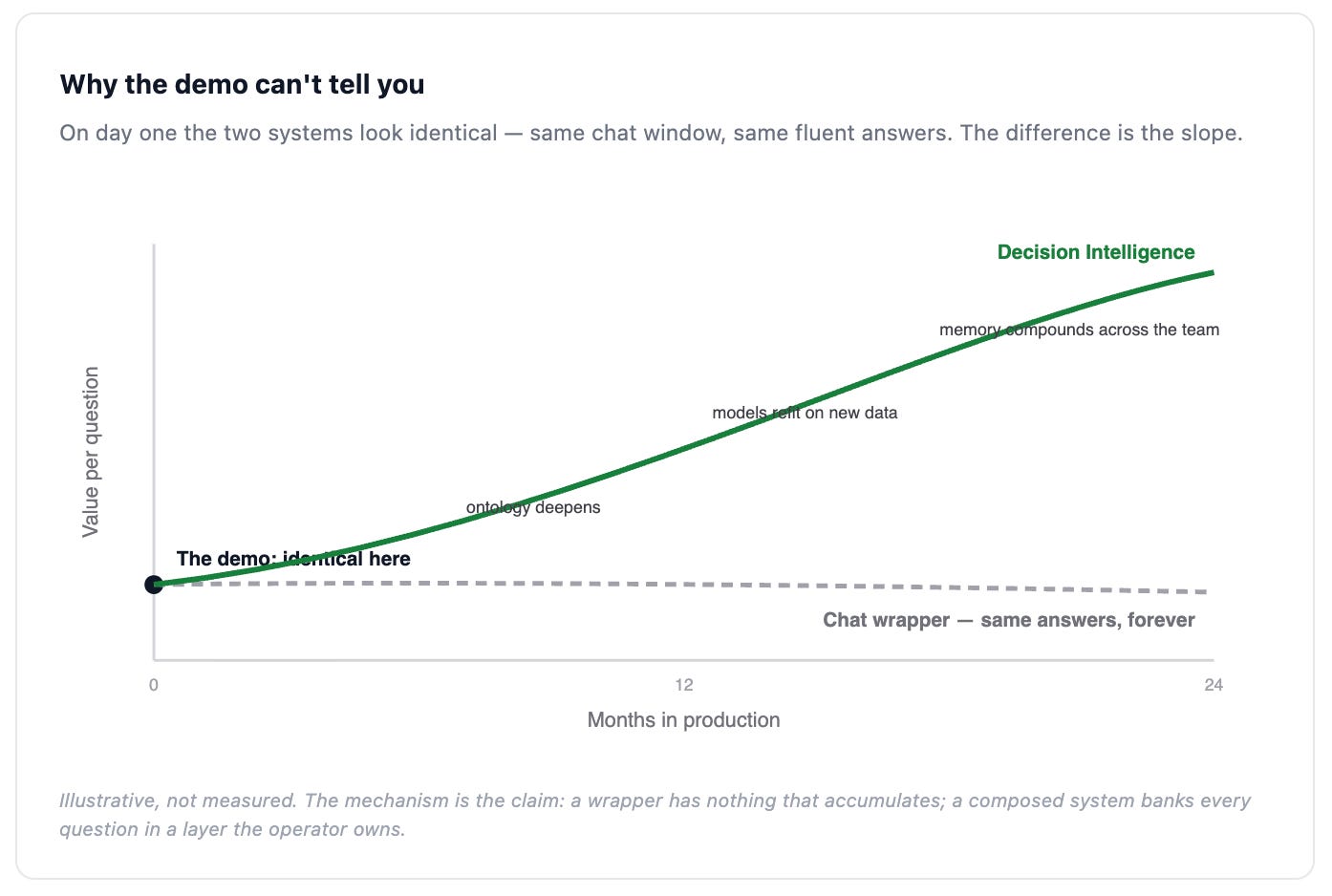
That is the standard we build against at SignalFlare — the ontology, the routing, the governance, the fitted models. Each advancement in the architecture compounds for the operators who own it. The demo is where every vendor looks the same. The architecture is where the future gets decided.
Companion piece: “The Four Bands of AI, Revisited” — the framework update, with the evidence behind the engine and failure-rate claims. Original framework: Signal Flare, “The Four Bands of AI,” January 12, 2026, with Fred LeFranc. Gartner estimates roughly 130 of the thousands of self-described agentic vendors are real (“agent washing,” June 25, 2025).
Read the original post and subscribe for updates here.
Share