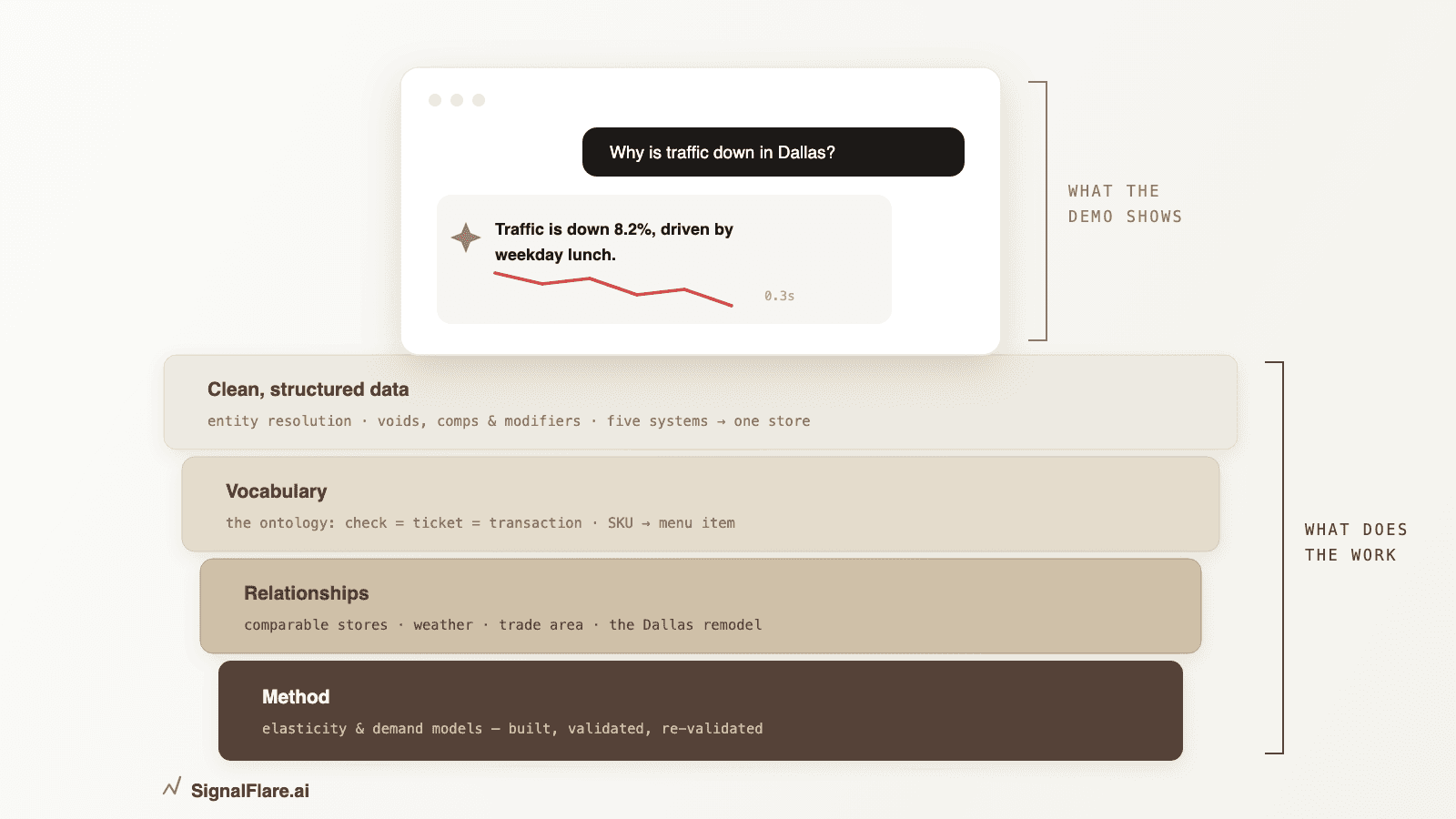

Inference costs on equivalent-quality AI workloads have fallen by roughly two orders of magnitude in 18 months. Open-weight models match the capabilities of retired commercial models at one-hundredth the cost. Aggregator inference clouds compete on price and speed every quarter. AI is getting cheaper, spend keeps climbing - the right architecture optimizes for results and total cost. Sourcing all AI through a single tier-1 vendor does not see those gains.
The reason is structural. Tier-1 vendors sell tokens. Their revenue model is per-token and their product trajectory drives per-task token consumption upward. Reasoning models bill for the model’s internal reasoning steps in addition to the visible output. Agentic workflows consume tokens across multi-steps rather than single calls. Each new generation uses more tokens per outcome than the last.
So, they need you to believe that you should build your entire technology stack on top of their token machines. At first it feels easy and cost-effective, but the faster they can deprecate the old models and trade up to the new ones, the more money you are spending. Suddenly the engineers and admins on your payroll start to look cheap in comparison. And you cannot leave, because every dashboard, every email campaign, every analysis, every system is wired to one frontier model provider.
That is AI lock-in and that is the tokenomics trap. The right question for an enterprise buying AI today is not “which tier-1 vendor do we standardize on.” It is: if AI efficiency is improving every quarter, how does that efficiency reach my bottom line?
The answer is architecture.
The three-tier supply chain
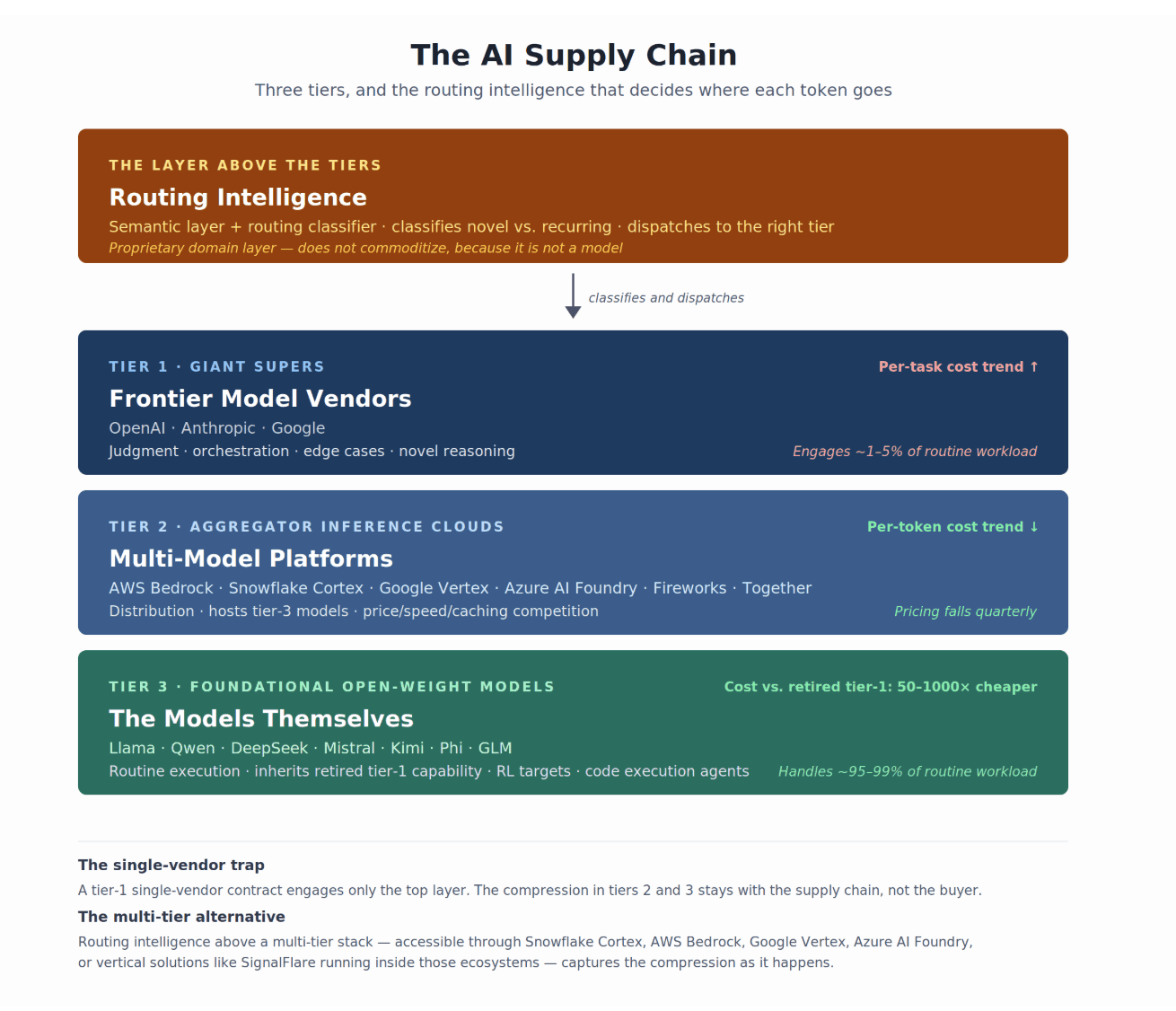
The AI supply chain has three layers, and the efficiency the headlines describe lives in two of them.
The first layer is the tier-1 frontier vendors. Their value is judgment — orchestration, edge cases, complex multi-step reasoning. Per-token pricing in this layer is stable or declining modestly, but per-task cost is rising as reasoning and agentic workflows expand consumption.
The second layer is the tier-2 aggregator inference clouds. These platforms host hundreds of model variants and compete on price, speed, caching, and throughput. Pricing here falls quarterly. Cached inputs at fractional rates, batch APIs at half price, and quantization options give buyers concrete cost levers without changing the work being done.
The third layer is the tier-3 foundational open-weight models. They can be self-hosted or accessed through tier-2 aggregators. New open-weight releases absorb the capabilities of retired tier-1 commercial models within months of those models being released. The replacement scores equal or higher on the same benchmarks. The price difference between retired tier-1 and current tier-3 equivalent is typically 50- to 1000-fold. Tier-3 is also where reinforcement learning targets, fine-tuning, and code execution agents are grounded.
A fourth dynamic sits on top of all three layers. Inside any production workload, the bulk of operations are routine. A polished AI output — a dashboard, a report, a marketing brief — is a sequence of dozens of micro-tasks. A small fraction of them require frontier reasoning. The rest are routine operations the system has done thousands of times before. Routing those operations to the cheapest capable tier is how the efficiency the open-weight and aggregator layers have produced actually reaches the workload.
A tier-1 single-vendor contract engages none of this. The vendor sells tokens at the prices the vendor sells tokens at. An architecture running only on tier-1 pays frontier prices for tier-3 work on every routine call.
Routing intelligence
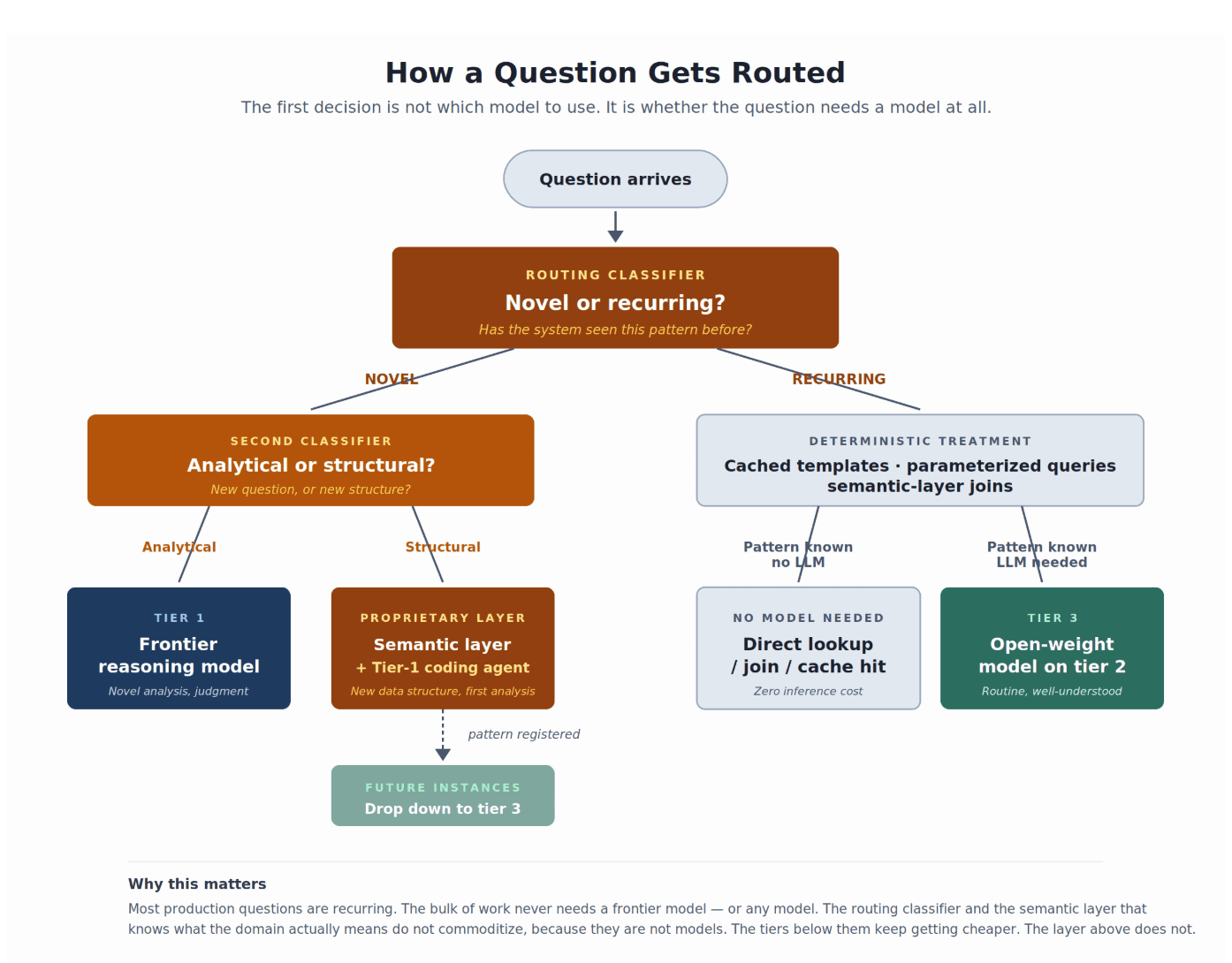
What determines which tier gets a token is the routing intelligence above the stack. The first decision a well-designed system makes about any incoming question is not which model to use. It is whether the question needs a model at all.
A good router classifies every request along a novel-versus-recurring axis before anything else. Most production questions are recurring — variations of patterns the system has seen before. These get deterministic treatment: cached templates, parameterized queries, semantic-layer joins. Many do not require an LLM at all. The ones that do can run on tier-3 because the work is well-understood.
Novel questions branch differently. Analytical novelty — a new kind of question against existing data — engages tier-1 reasoning. Structural novelty — setting up a new data source, kicking off a first-time analysis, merging complex data across previously unrelated systems — engages a semantic layer paired with a tier-1 coding agent. Once the structural work is done and the pattern is registered, subsequent instances drop down the stack toward tier-3 execution.
This is the part of the architecture that does not commoditize. The tier-1, tier-2, and tier-3 model providers will continue to compete and prices will continue to fall. The semantic layer that knows what a particular domain actually means when it asks a particular question is accumulated domain knowledge with a routing classifier on top, not a model. It does not get cheaper, because nothing in the supply chain is making it cheaper.
A production sample
The architecture above is not theoretical. SignalFlare runs it. A random sample of platform traffic drawn from within the past 90 days processed approximately 1.4 billion tokens. In that sample, tier-3 models served via tier-2 aggregators absorbed 99.93% of token volume. Tier-1 frontier vendor models handled 0.07% — orchestration, judgment, and the semantic-layer-paired coding work for new data structures. Total inference cost at actual paid rates on the sample: approximately $820.
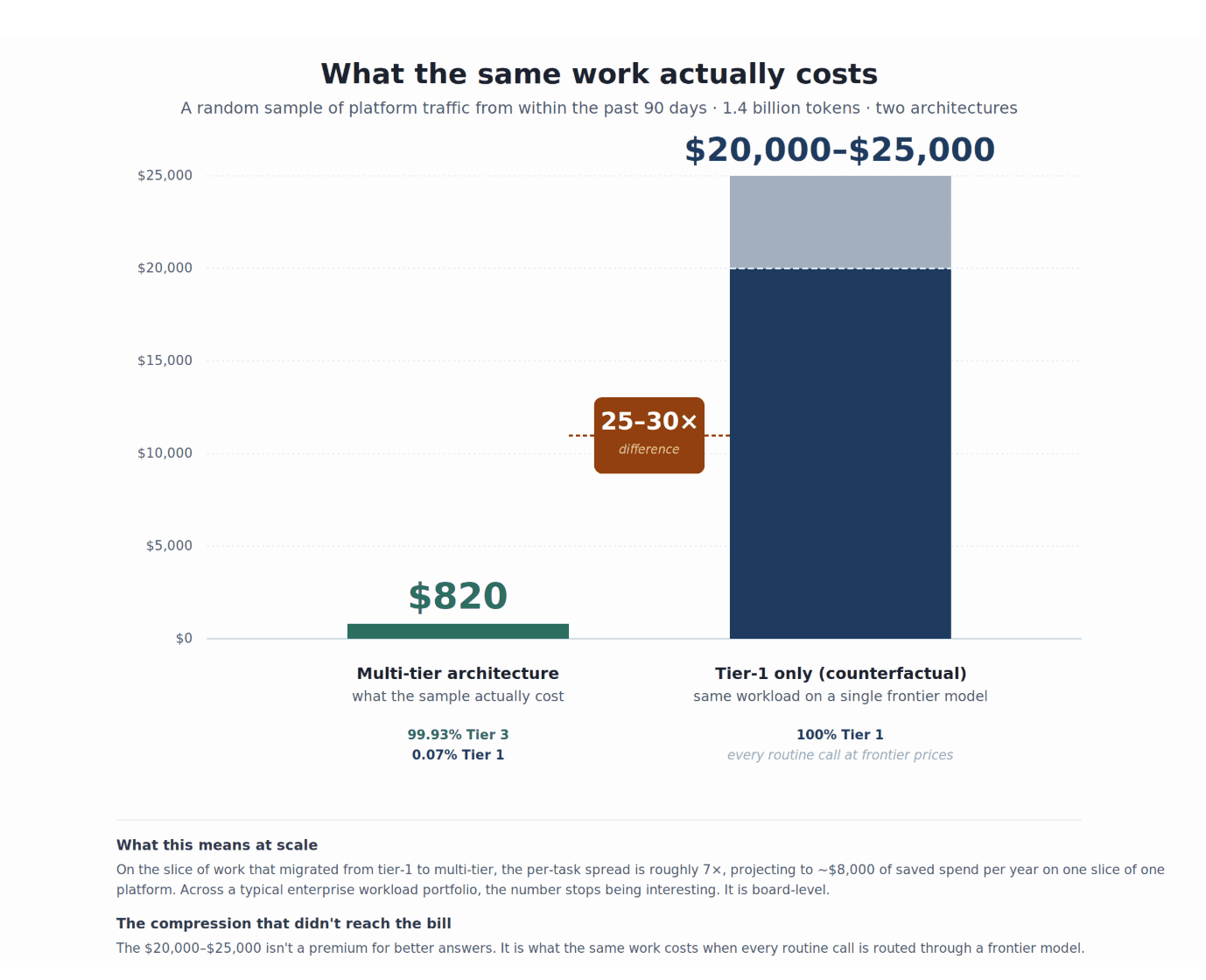
The same sampled workload run on a single tier-1 frontier model would have cost between $20,000 and $25,000 — a 25- to 30-fold difference. For the slice that specifically migrated from tier-1 APIs to tier-3 models on tier-2 hosts, the spread is 7-fold on a per-task basis, projecting to roughly $8,000 of saved spend per year on one slice of one platform. Across a typical enterprise workload portfolio, that becomes a board-level number.
These numbers move in one direction over time. Tier-3 quality continues to catch up to retired tier-1 frontier capability. Tier-2 aggregator pricing continues to fall. The routing layer captures both effects. A single-tier-1 contract captures neither.
The retirement cycle
Tier-1 vendor retirement cadence is now measured in months, sometimes weeks for preview and experimental releases. Models are deprecated faster than enterprise procurement processes can finish papering the contracts that depend on them. The workloads on those retired models migrate — sometimes to the next-generation tier-1 replacement at higher prices, more often to tier-3 open-weight equivalents served via tier-2 aggregators. The replacements score equal or higher on the same benchmarks the originals led on at retirement.
The tier-1 vendors are themselves the source of the migration pressure. Every model they retire pushes another wave of workloads down the tier stack. For a locked-in buyer this is a continuous migration project running on the vendor’s schedule, with prompt rewrites and version-upgrade work coming out of the engineering budget. For a routing buyer the same dynamic is an automatic cost-reduction mechanism: as soon as the new tier-3 equivalent is available, routing shifts and the per-task cost drops.
What is strategic
Token optimization is a tactic, not a strategy. An enterprise AI platform whose competitive position depends on cheaper tokens or generic routing infrastructure has no defensible advantage, because the price floor keeps falling and there is nothing proprietary about model routing.
The strategic questions are different: what work the tokens are doing, and whether the system using them has the domain knowledge to do that work well.
SignalFlare runs the three-tier architecture and the routing layer above it to capture the efficiency the AI supply chain produces. The actual work is decision intelligence — taking domain data, identifying signal in it, generating recommendations with measurable financial impact, and tracking whether those recommendations produced the expected lift. The competitive advantage is the semantic layer, the routing classifier, the data pipeline, the recommendation logic, and the closed-loop measurement of outcomes. The product is the decisions and the measured results, not the tokens.
Tier-1 models remain high value for reasoning and novel or highly complex problems. The question isn’t whether to use them, it’s where in each process they need to be invoked. When used as the single source of enterprise AI, the token economics makes it hard to recognize efficiencies.
Looking Forward
Tier-1 vendors are innovating beyond models and tokens. They are building remarkable platforms that instantly produce dashboards, surface insights, display outcomes, and put models into builders’ hands quickly. This is good for the ecosystem. And thanks to competition across these vendors and beyond, the innovations that appear in tier-1 are not isolated there for long. It may feel more efficient to build straight from a tier-1 platform — but the economics of that become startlingly diseconomic very quickly.
What it does not change is the base economic model underneath, and the base economic model is what determines what happens next. Tier-1 vendors sell tokens. Per-task token consumption keeps rising. The supply chain below them keeps getting cheaper. A workload wired entirely through a single tier-1 vendor cannot capture that cheapening, no matter how good the platform layer above it is.
Single-model vendor lock-in looks the most affordable at first, because it’s priced low to start. The long-term costs compound quickly, especially when there is no vertical semantic and ontology layer above the platform — the layer that lets the compression in the supply chain below actually reach the bill.
Read the original post and subscribe for updates here.
Share