
Anyone on your team can now produce a confident, chart-filled analysis in about thirty seconds. So can someone on another team. Same data, same AI assistant, different answers, and sometimes no obvious way to tell which one is right.
This is the new reality now that we're on year four of ChatGPT's introduction to the market. We see chatbots and new AI platforms popping up throughout your tech stack, each making promises that sound vaguely similar.
The truth is that there's a time and place for each of them; we use them in administrative work ourselves.
What we want to do here is draw one line clearly: the difference between products built to help you talk to your data and what we do, which is decision intelligence.
The promise everyone is selling
Restaurant executives are hearing the same pitch in different words. Talk to your data. Ask your data a question. Chat with your POS. AI in the office suite, AI in the browser, AI bolted onto software you already pay for. Somewhere in your building, someone has already pointed a chat window at the data warehouse to see what happens.
Keep all of it. We mean that. We use Claude for administrative work every day at SignalFlare. Copilot makes moving through files in SharePoint faster. If a tool makes your people better at documents, email, and research, that's real value and you should take it.
But look closely at what "talk to your data" promises. The promise is access. And access assumes the only thing between you and a good decision is the technical translation of turning a question into a data query.
We're here to tell you access is not the problem.
A better model won't fix it
You might also assume that getting better results out of AI is a timing problem. The models keep getting better. Wait a year and the gap will close on its own.
The AI model is not the problem either. Models are as good as the meaning that they can derive from the information they're given. They're designed to be single player assistants that can use their statistical foundations to give you the most likely good response, and they're getting better at that all the time.
But you shouldn't be relying on the model to give you meaning. Meaning is context and it lives outside Claude — in how your data is structured, how terms are defined in your business, which method applies to the decision you're making.
What your POS knows
Say you want to understand performance trends across your stores. You have options. Use the assistant built into your POS. Or load the data into a warehouse with an agentic AI feature and ask it there.
Your POS holds transaction data, which is a necessary ingredient towards utilizing AI to get the insights you want. The next ingredient is context. The AI doesn't know that Wagyu Burger v3 and Wagyu Burger v4 are the same item. It doesn't know which of your stores are comparable, or that the Dallas remodel closed the patio for six weeks, or what your team means when they say "traffic."
Without context, you can ask a chatbot to try to give you traffic trends with the data as is, but you won't get an answer. You will get a fluent guess, formatted like an answer. In order for the AI to accurately orchestrate choosing which columns to query, how to interpret them, and then how to reason over the results of the math, it must know your business, your industry, your data definitions, and what methodology to use per the decision you're working towards.
So while access is no longer the bottleneck, developing and maintaining meaning (aka context), derived from your data and knowledge, very much is.
The complexity of context
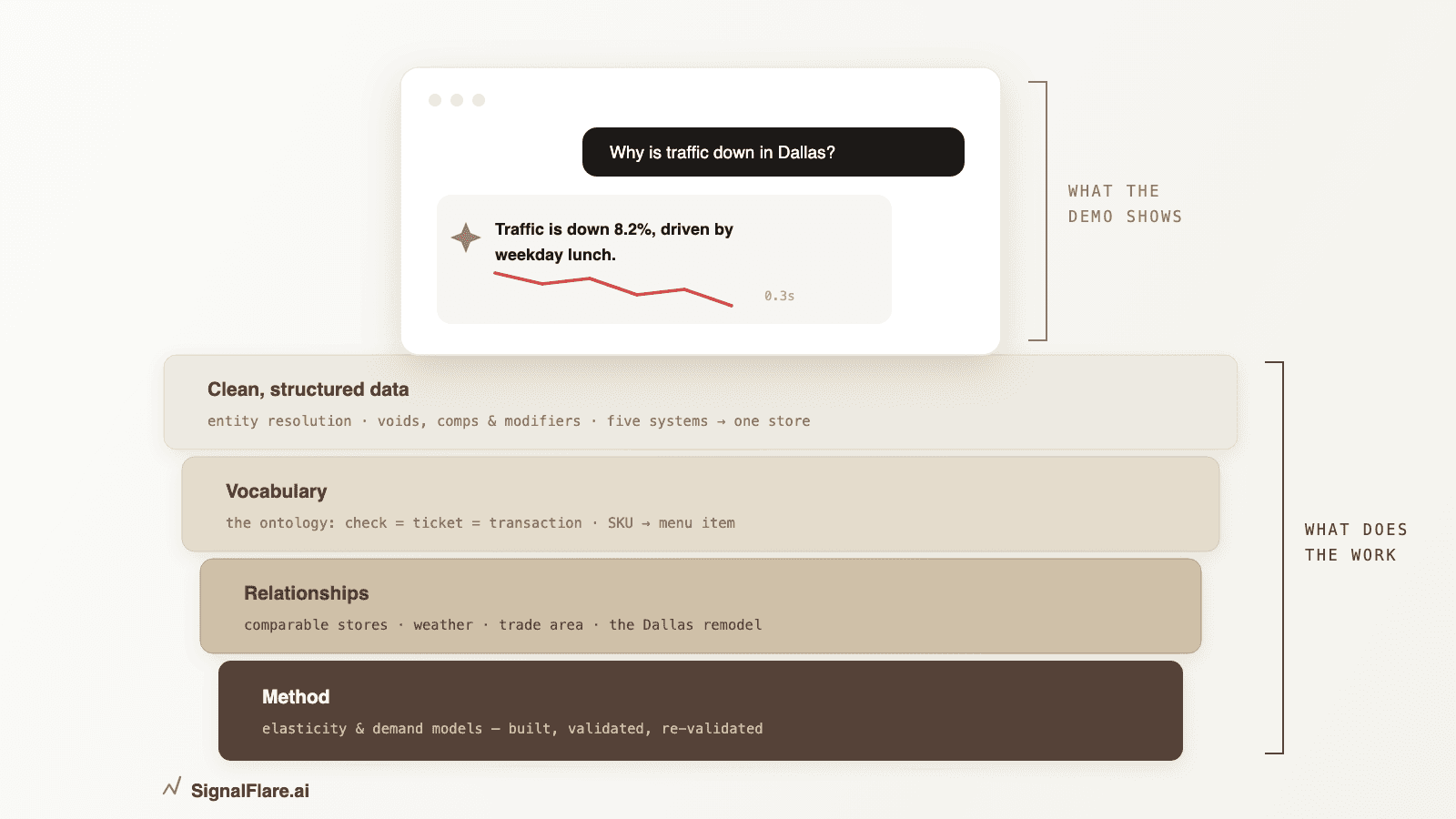
Context isn't a document you write once and hand to a model. It's layered, and each layer takes work that requires extensive resourcing. Of the many factors involving context management, some big ones include:
Clean, structured data. Before meaning comes hygiene. Data arrives from your POS as nested JSON or normalized tables full of pointers, and then it has to be extracted, flattened, and made queryable before anyone can ask it anything. Duplicate locations across five systems have to resolve to one store. Voids, comps, discounts, and zero-price modifiers have to be handled consistently or your product mix is misunderstood in a critical analytical workflow.
Vocabulary. What is an item, a store, a daypart, a comparable location, a net sale. Sounds trivial until you find four formulas of check average living in three departments and one spreadsheet. This is what an ontology does: it's the agreed structure that says a check, a ticket, and a transaction are the same object, that this SKU and that SKU are the same menu item, that these forty locations are one brand.
Relationship. A university location behaves nothing like an airport location. A store with three competitors inside a mile isn't the peer of one with none. Weather, seasonality, local events, trade area demographics — these change what a number means, and none of them live in your POS.
Method. Knowing that sales dropped is not knowing why, and knowing why is not knowing what to do. Whether you should move price on an item depends on elasticity, and elasticity comes from a model that has to be built, validated, and re-validated against what actually happened.
What we don't see in AI marketing materials often is that context decays. You launch an LTO. You remodel forty stores. You migrate POS systems and every item ID changes. Menus get rebuilt twice a year. Every one of those events can break the mapping underneath your reporting, and if nobody owns keeping it true, the answers drift while looking exactly as confident as they did before.
That's the work. It's slow, it's unglamorous, and it's the reason most AI pilots stall at the demo.
From data to decision intelligence
Everything that goes into managing context is the prerequisite and ongoing work that we at SignalFlare do for our customers, and there's no way to skip it.
Mapping your data into a model of how restaurant data behaves. Agreeing on definitions. Testing methodologies against what actually happened. That work is a big piece of what we sell.
These activities are foundational to decision intelligence: your data, advanced analytics, AI, and human judgment in one place, pointed at a specific decision.
So when our platform Navigator tells you how demand will respond to a price move, that number comes from the same statistical model running on your validated data each time. It's computed, not generated. No language model is guessing at it.
Utilizing your context
Context is just the beginning and we will continue to expand on this in the rest of this blog series. Beyond context is orchestration, what takes you beyond AI assistants into AI workers doing real work with your data and business information to help you achieve better outcomes with your decisions.
When we ask Navigator a question, the question doesn't go straight to a language model. It gets classified first: what kind of question is this, and what should answer it. Some things have to come out the same way every time you ask — a revenue figure, an elasticity, a forecast. Those go to code and to statistical models fitted on your data.
So we use large language models (LLMs) for what they're good at: language. Interpretation, synthesis, and explanation are all great use cases for LLMs, not arithmetic.
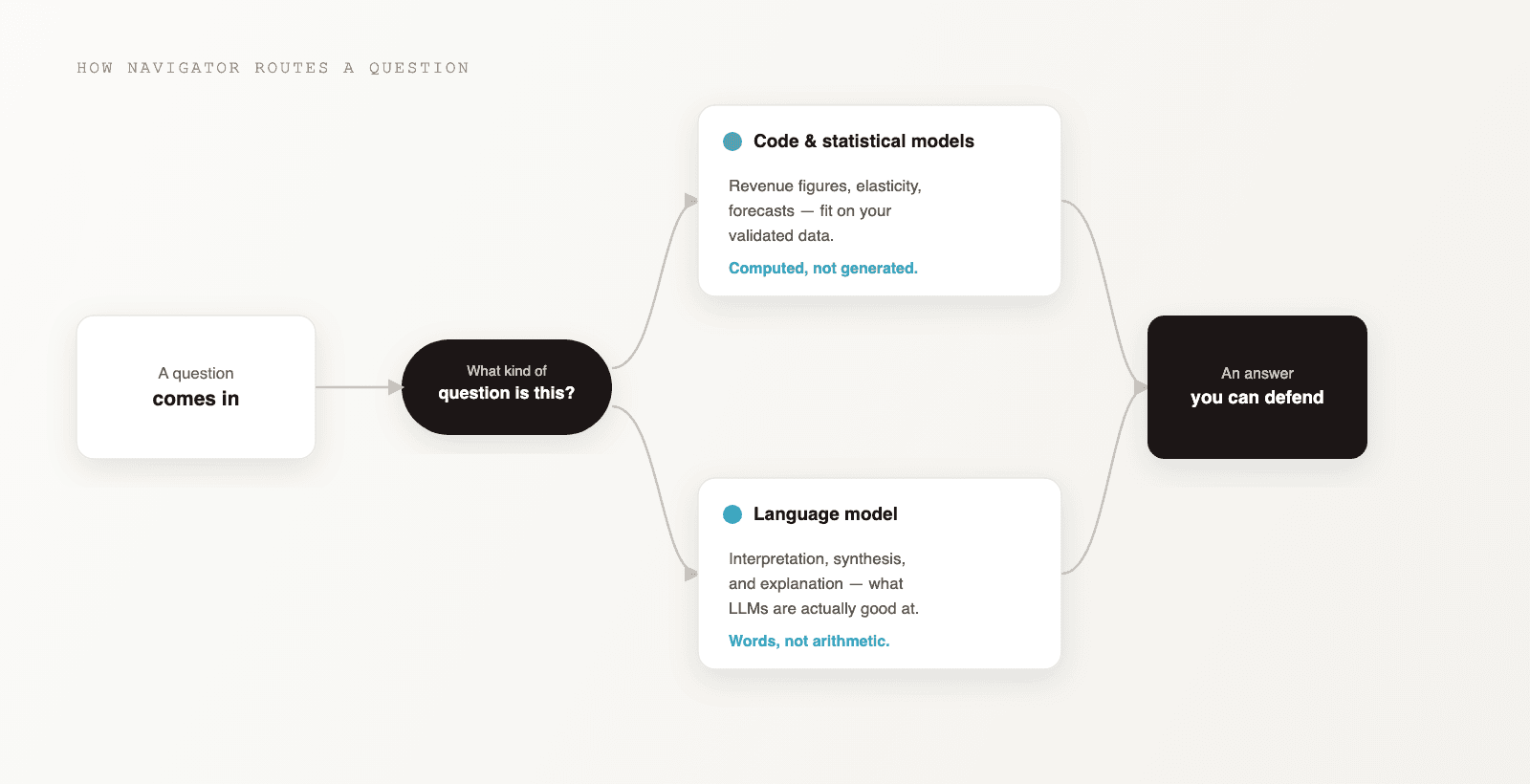
The routing system that we've built is the difference between a system you can defend and one that can confidently cost you millions. In most agentic products, a language model sits on top as both the interface and the decision-maker, which puts the one component capable of making things up in charge of deciding when accuracy matters.
Behind the routing sits everything that isn't AI at all: ingestion pipelines running daily, transformations, validation checks, entity resolution, mapping to the ontology, models being refit as new data lands, monitoring for when something upstream breaks. Our engineering team spends far more time on that than on anything model-related. The AI is the last mile.
(For the architectural version of this argument — routing, governance, and why the substrate is the product — see Mike Lukianoff's "It's Time for Decision Intelligence.")
ROI
To bring this all home, let's look at the economics. Context management might sound more expensive because it includes humans in the loop. What most don't realize is that when you skip this step, connect an agent directly to a data warehouse, and let it write its own queries, eventually one runaway job will result in a five-figure compute bill for the month. Nobody did anything wrong, necessarily. But it happens because too of the work is given to the LLM which will guess and guess and guess its way to something that seems accurate.
This is where the investment in context pays off. Those hours spent structuring data are one-time investments and small ongoing management fees — once the system knows what a comparable store is, it knows for every question after that.
What starting right looks like
Most restaurant AI projects start as a pilot on top of raw data and quietly stall. Nothing to trust, no methodology, and six months later, no decision anyone can point to and say AI made that one better.
Start from the other end. Start with the decisions. We will work with you to build the needed context for the methodologies that we have tested across hundreds of brands to produce trustworthy recommendations. You begin with a few curated experiences and our people working alongside your team, and the platform earns more responsibility over time. The context doesn't go away and can be used for the next decision — each starts smarter than the last.
So keep the tools that make your people faster. Use them for everything they're good at.
But when the answer has to be true about your business, look for decision intelligence.
Share

